Is Indian Money Actually Flowing Into African Startups? The Honest Answer
Search for "India-Africa startup partnership" and you'll find no shortage of conference panels, MoUs, and speeches about the two economies' shared destiny in fintech, mobile payments, and digital innovation. It's a genuinely appealing narrative: India built globally competitive digital public infrastructure and a deep venture ecosystem; Africa has the continent's own fintech and mobile-money boom, led by companies like Flutterwave and the M-Pesa ecosystem. Two natural partners, the story goes.
The 2025 funding data tells a much more modest story.
What actually happened in 2025
African startups raised $3.9 billion across 506 deals in 2025, according to industry tracking cited by Africa Global Funds — a year the continent's venture market is described as "steadying" after two rough years of pullback. East Africa accounted for more than two-thirds of regional deal value. Domestic African investors hit a record share of venture commitments, at 45% of the total. Venture debt nearly doubled to $1.8 billion.
Nowhere in the credible roundups of 2025 African venture activity — not in deal announcements, not in investor rankings, not in sector breakdowns — does Indian capital show up as a distinct, visible category. That's not because reporters are ignoring it. It's because, at the scale that shows up in continent-wide funding data, it largely isn't there yet.
Where the confusion comes from
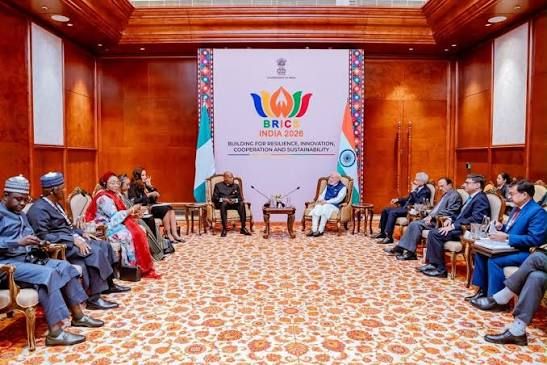
There are real, specific connections between India and African tech that make the "partnership" framing feel true even when the aggregate numbers don't support it. Indian tech companies have run partnership programs with African platforms — for instance, providing free website tools to small businesses through Flutterwave's merchant network. Individual Indian-origin fund managers and Indian-founded companies with global mandates do occasionally write checks into African deals. And Indian and African founders regularly appear together at investor showcases and pitch events built specifically to spark that kind of cross-border interest.
None of that is nothing. But it's also not the same as Indian venture capital being a meaningful line item in Africa's funding stack, the way American, European, and increasingly domestic African capital already are.
Why the money hasn't followed the rhetoric
A few structural reasons help explain the gap. India's own venture ecosystem is enormous and still hungry for capital domestically — Indian fund managers don't need to look overseas for deal flow the way a smaller market's investors might. Currency and repatriation friction make cross-border African bets operationally harder for Indian funds than deploying at home. And most Indian institutional capital that does go abroad has historically gravitated toward markets with clearer, longer track records — the US, Southeast Asia — rather than a continent whose venture ecosystem, while growing fast, is still young and concentrated in a handful of hub cities.
The honest conclusion
India-Africa tech "partnership" is real at the level of trade delegations, government MoUs, and individual company tie-ups. But if the question is specifically whether Indian venture capital is flowing into African startups at meaningful scale — the answer, based on the actual 2025 numbers, is not yet, and not much. That could change; Africa's venture market is young enough that a handful of large Indian fund commitments could genuinely move the visibility needle within a year or two. It just hasn't happened yet, and treating the rhetoric as if it has would be misleading readers trying to make real business decisions.
A note on confidence: this article relies on continent-wide 2025 venture funding roundups, which are generally reliable directionally but can undercount smaller or unannounced deals — it's possible some Indian participation exists at a scale too small to register in aggregate reporting. If you're aware of specific, verifiable Indian VC activity in African startups, that would be a useful correction to this piece.