India's Solar Alliance Promised to Power Africa. Here's the Reality Check.
The case for the International Solar Alliance is genuinely strong on paper: Africa receives roughly 3% of global energy investment despite having some of the best solar potential on Earth, and a large share of the more than 730 million people worldwide who still lack electricity access live on the continent. India, through the ISA — headquartered near New Delhi and co-founded with France in 2015 — positioned itself as the country willing to close that gap, offering concessional financing, technology transfer, and risk-reduction tools rather than just aid.
What's actually working
The mechanics are sound. The MIGA-ISA Solar Facility partners with the World Bank's Multilateral Investment Guarantee Agency to provide political risk insurance for solar projects, directly addressing the reason many private investors avoid African energy markets in the first place. A partnership with the African Development Bank's Desert to Power initiative extends this further, and ISA-backed demonstration projects are running in eight countries, focused on practical needs: solarizing health centers, schools, and irrigation systems.
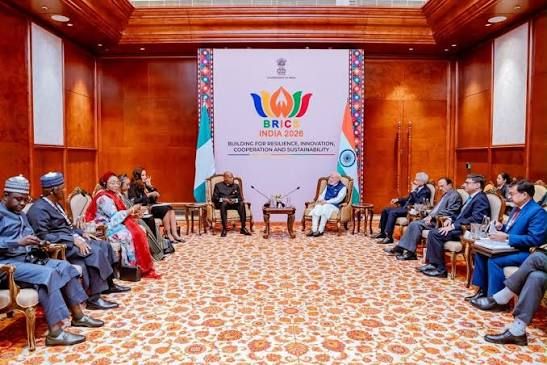
Ethiopia is a clear example of why this matters concretely. Over 45% of its population still lacks electricity access, and its grid remains roughly 90% dependent on hydropower, leaving it acutely exposed to drought. Rooftop solar, off-grid electrification, and solar-powered irrigation aren't abstract policy goals there — they're a direct answer to a real vulnerability. South Africa's relationship with the ISA is structurally different and worth naming: as fellow BRICS members, India and South Africa engage as peers here, not as donor and recipient.
The honest reality check
Separately from the ISA-specific numbers, Africa's broader solar sector had a strong 2025 independent of any single alliance's efforts — by some measures the fastest-growing solar region in the world alongside China and the Middle East, with actual installed capacity likely underreported by official statistics. That broader boom is real and largely not about the ISA.
The ISA's own flagship Africa Solar Facility, launched in 2024, has mobilized $74 million toward its $200 million target — a real shortfall, with on-the-ground reporting describing the facility as not yet fully operational. And despite the ISA counting over 120 member countries across four continents, its activities are still funded mainly by India's own Ministry of New and Renewable Energy: as of recent public disclosures, member countries other than India had committed only around $5.6 million combined, of which roughly $3.9 million had actually been mobilized. Separately, of 50 planned Solar Technology & Application Resource Centers, only about 22% were operational as of the most recent assessment, and a Viability Gap Funding scheme meant to de-risk projects for private investors was discontinued in 2025 without measurable results.
This isn't a story of failure, but it is a story worth being honest about: India set out to lead a genuinely global, cost-shared coalition for Africa's solar transition. What's actually happened, so far, is closer to India funding most of it alone while the "alliance" part of the alliance hasn't fully materialized.
What this means practically
If you're evaluating a solar opportunity tied to the ISA specifically, the honest picture is that real technical infrastructure and genuine political-risk mitigation tools exist, but funding behind any specific project may be thinner and slower-moving than the alliance's public messaging implies. Verify the current, actual funding status of a specific project before treating an ISA announcement as a completed commitment.
Note: the $74M-of-$200M target, the $5.6M/$3.9M non-India contribution figures, and the 22% STAR-C completion rate are drawn from recent but time-sensitive reporting and should be checked against current ISA financial disclosures before citing. The MIGA-ISA Solar Facility and Desert to Power partnerships are confirmed, real structures; individual project funding status should be verified independently.